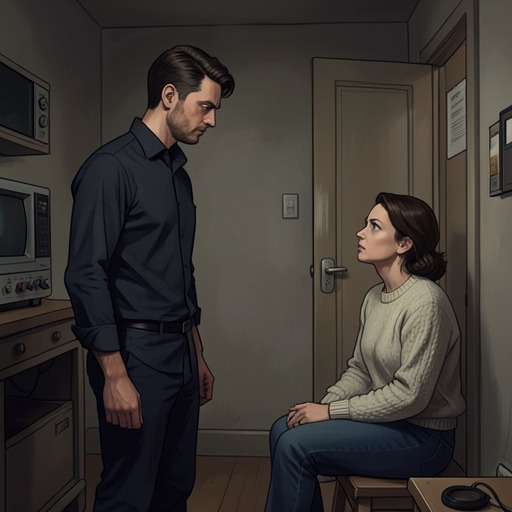
Reese tells Tom about his trauma
Off CampusReese tells Tom about his sexual assault in a conversation that turns an unexplained startle response into a difficult account of what happened and what remains unresolved. His disclosure helps Tom understand Reese’s fear and guardedness, but it does not make the trauma disappear: the scene also exposes the limits of Tom’s instinctive anger and the care required when they approach physical intimacy.
The Disclosure and Its Immediate Context
The conversation begins in the body before it begins in words. When Tom enters, Reese wheels around so abruptly that his loose hair swings out, then drags his desk chair between himself and the door. Bare-chested and breathing hard, he grips the chair with white fingers; his eyes are wide and blank. Tom freezes, afraid Reese might raise the chair and shove it at him, and recognizes that Reese is not pretending. The startle response makes the room itself part of the disclosure: Tom’s return to what he regards as his rightful place coincides with Reese’s experience of the doorway as a threat.
After Reese puts the chair away and sits on the edge of his bed, he acknowledges that his reactions are sometimes not normal. Tom tries to reassure him, though his casual claim that Reese seems mostly all right is plainly an understatement. Reese explains why he has returned to Perkins: the school had to make a promise to his father before the father would permit him to come back, and the arrangement also kept him from going to the press. The explanation places Reese’s return within an institutional and family negotiation, but the conversation soon turns from the terms of his return to the harm that makes the room difficult to inhabit.
Reese folds himself into the corner of his bed, heels dug into the mattress, arms wrapped around his knees and mouth hidden behind them. Tom understands that asking the wrong question could feel like startling him again, so he stays quiet and listens. This physical retreat gives the account its shape: Reese speaks from a position of concealment, while Tom tries, not always successfully, to let Reese determine how much he says.
The Assault and Its Delayed Disclosure
Reese describes having shared a room the previous year with an athlete who mostly ignored him when they were alone. The situation changed when the roommate’s teammates came around: they called Reese a slur and made crude jokes about whether he liked being sexually penetrated, while the roommate laughed along. The distinction matters to Reese’s account. He presents the roommate not as an openly hostile presence at every moment, but as someone whose conduct shifted in front of his friends—and whose eventual failure to intervene would become difficult for Reese to name as wrongdoing.
One night, Reese says, the men came into the room while he was asleep and held him down. He had been drinking at a party and was so intoxicated that he did not remember who had walked him back to the dorm. He cannot identify everyone who was there; the roommate is the sole person he can place with certainty. Reese offers no further physical detail. His brief wording keeps the event’s violence clear without making him recount it in humiliating detail, and he looks directly at Tom as if asking him to understand without requiring more explanation.
The assault was not reported immediately. Reese says there was little the school could do when he eventually told someone, and that the first route by which his situation came to attention was an accusation that he possessed sleeping pills without a prescription. The medication was not simply an answer to difficulty sleeping. Reese’s reply leaves Tom to recognize that it was connected to a more dangerous struggle, one Reese remains engaged in. The disclosure therefore reveals not only the assault but also the delay, the indirect path to discovery, and the continuing consequences that Reese had not initially put into words.
Reese also says he could not quite get angry at the roommate, because he did not believe he was a bad person deep down. Tom reacts with anger rather than the understanding Reese is trying to elicit. He demands that Reese call the roommate a bad man and asks whether he stopped the assault or told the others to stop. Reese answers that, during the assault, the roommate did not do anything to him directly and was not near him at the moment he could see him. Tom’s questions press on the difference between not carrying out the assault and failing to prevent it. His outrage recognizes the gravity of that failure, but the force of his response risks turning Reese’s complicated feelings into another thing Reese must defend.
A Pact of Care, Not a Cure
Tom’s anger gives way to a promise of recovery that is more certain than his knowledge allows: he tells Reese that he will get past this, even if it takes hundreds or thousands of hours with a therapist. Reese quietly points out that he does not have one. Tom is surprised that the school has not connected him with anyone, and he tries to make his own therapy contingent on returning to athletic practice. Reese turns that proposal into a reciprocal bargain: he will go to therapy when Tom goes to practice. It is an attempt to make care mutual, joining Reese’s treatment to Tom’s return to a routine he has been avoiding; the exchange does not establish that either promise is fulfilled. That night they lie fully dressed on top of their separate beds, awake and listening to one another breathe, while Tom wonders what boundary they have crossed.
The disclosure becomes a reference point in later intimacy, where understanding has to be shown through decisions rather than claimed as a cure. When a kiss turns forceful, Reese says, “Wait.” Tom immediately lets go. Later, Reese explains that this kind of touch is different and gives Tom permission to touch him, while also setting a specific limit: Tom must not hold him down or move his body. Tom agrees and proceeds only after Reese has made the boundary clear. The exchange does not erase the assault or make consent automatic; it shows Reese naming the conditions under which he feels able to choose, and Tom stopping when asked and adjusting to those conditions.
That attentiveness remains imperfect and concrete. Before performing oral sex on Reese for the first time, Tom has spent hours in his cab trying to plan how to avoid bringing painful memories to the surface. He chooses to kneel, but the pillow he drops to the floor makes a sharp sound that startles Reese into stepping back and crossing his arms over his chest. Tom’s preparation cannot anticipate every trigger; the moment makes the gap between good intentions and predictable safety visible. Later, after being together has left Reese feeling worse, Reese tells Tom so directly, adding that his “plate of things that make me feel shitty is kinda full already.” His account is not a single confession that closes the past. It continues to shape what he can bear, what he asks for, and how the two men must negotiate closeness.
Significance
The conversation changes what Tom can understand about Reese, but understanding does not confer mastery over Reese’s experience. Reese’s account links an abrupt physical reaction in their room to an assault, delayed disclosure, medication, and unresolved feelings about the roommate who failed to stop it. Tom’s response moves between silence, clumsy reassurance, anger, and promises he cannot guarantee. The later scenes carry that tension forward: trust is approached through explicit limits, immediate stopping, and attention to Reese’s response, while mistakes and distress remain possible. The disclosure therefore marks not a cure through intimacy but the beginning of a more demanding form of care, one that requires Reese’s agency and does not confuse being loved with being healed.